

Wheel spacers are the cheapest way to make a compact tractor feel planted on a side hill, and the wrong ones are the fastest way to strip a stud or crack a wheel. The difference comes down to three numbers most owners have never measured: the bolt pattern (how many lugs, and how far apart), the center bore (the hub's pilot diameter) and the stud thread pitch. This guide shows you how to measure all three on your own tractor in about ten minutes with a tape measure, a caliper and a $10 thread gauge, and what to do with the numbers once you have them.
First: you may not need to measure at all.
Our Bora aluminum and Stahl steel tractor wheel spacers are machined in the USA to the exact hub and wheel pattern of the machine you pick from the list — John Deere, Kubota, Kioti, Mahindra, New Holland, LS, TYM, Massey Ferguson, Branson, Bobcat, Yanmar, RK and more. If your tractor is on the list and it still wears its factory wheels, choose the model, choose front or rear, choose a width, and you're done.
Measure when: your model isn't listed · you're running aftermarket or swapped wheels · you aren't sure which sub-model or hub you have · or you just want to confirm before ordering a custom-machined part.
The three measurements that decide whether a spacer fits
A wheel spacer is a machined disc that sits between your hub and your wheel. One face bolts to your tractor's studs; the other face carries a new set of studs for your wheel. For that to work, the spacer has to match your tractor in three places:
| Measurement | What it is | Why it matters | Tool |
|---|---|---|---|
| Bolt pattern (lug count × lug spacing) | How many studs, and the diameter of the circle they sit on, e.g. 5 × 4.5" or 6 × 205 mm | The spacer's holes must land on your studs. Even 2 mm off and it will not seat flat. | Tape measure or caliper |
| Center bore (hub bore) | Diameter of the raised pilot ring on the hub that the wheel's center hole slides over | A hub-centric spacer centers on this lip. That's what keeps the wheel from vibrating and takes shear load off the studs. | Caliper |
| Stud thread size & pitch | Diameter of the stud plus threads per inch (SAE) or millimeters between threads (metric), e.g. 1/2"-20 or M12 × 1.5 | The spacer's nuts thread onto your studs; your lug nuts thread onto the spacer's studs. Wrong pitch = cross-threaded studs. | Thread pitch gauge (or a known nut) |
There's a fourth number, spacer width, but that one is a choice rather than a measurement. We'll cover how to pick it after the measuring is done.
How to measure lug spacing (bolt pattern) on a tractor
Bolt pattern is written as number of lugs × bolt circle diameter. The bolt circle is the imaginary circle that passes through the center of every stud. How you measure it depends on whether you have an even or odd number of lugs.
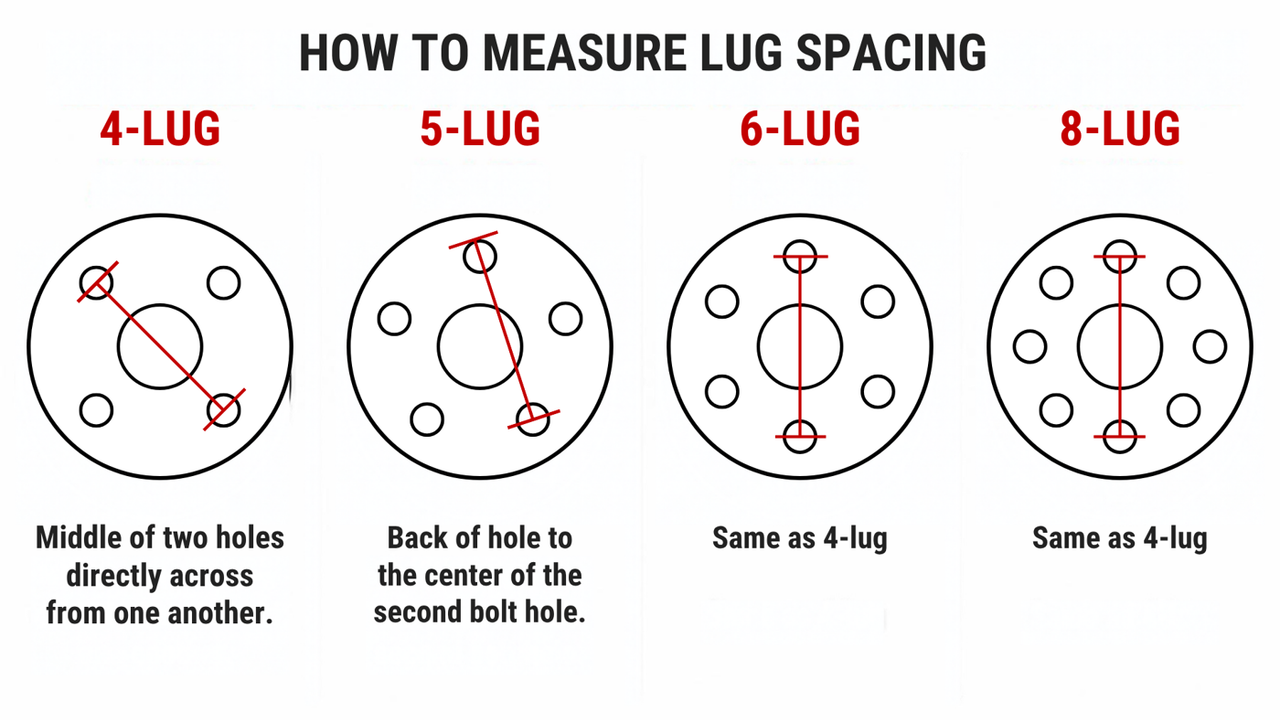
4-, 6- and 8-lug hubs (even count)
Pick any stud, then find the stud directly across the hub from it. Measure from the center of the first stud to the center of the opposite stud. That distance is your bolt circle diameter. Because the two studs are exactly opposite, you're measuring straight through the center of the circle.
5-lug hubs (odd count)
Five studs have no stud directly opposite, so a center-to-center measurement across the hub reads short. Instead, measure from the back (outer edge) of one stud hole to the center of the second stud over (skip the stud next to it). That skip-one, edge-to-center measurement lands very close to the true bolt circle diameter. Six and eight-lug hubs on larger utility tractors measure exactly like a four-lug: straight across, center to center.
Three tips that prevent bad numbers
- Measure the hub, not the wheel. Wheel holes are slightly oversize and some aftermarket wheels are drilled for two patterns. The studs on the hub are the truth.
- Convert before you compare. Tractor patterns come in both units. 4.5" = 114.3 mm, 5" = 127 mm, 5.5" = 139.7 mm, 6.5" = 165.1 mm, 8" = 203.2 mm. If your tape reads "a hair over 4.5"," it's almost certainly 114.3 mm, not 115.
- Measure front and rear separately. On most 4WD compact tractors the front hubs and rear hubs use different bolt patterns, different bores and sometimes different stud sizes. Never assume the rear number applies up front.
How to measure center bore (hub bore)
Look at the face of the hub with the wheel off. In the middle you'll see a raised ring, the hub pilot. The wheel's center hole slides over this ring, and on a hub-centric spacer the spacer's bore does too. What you want is the outside diameter of that pilot ring.
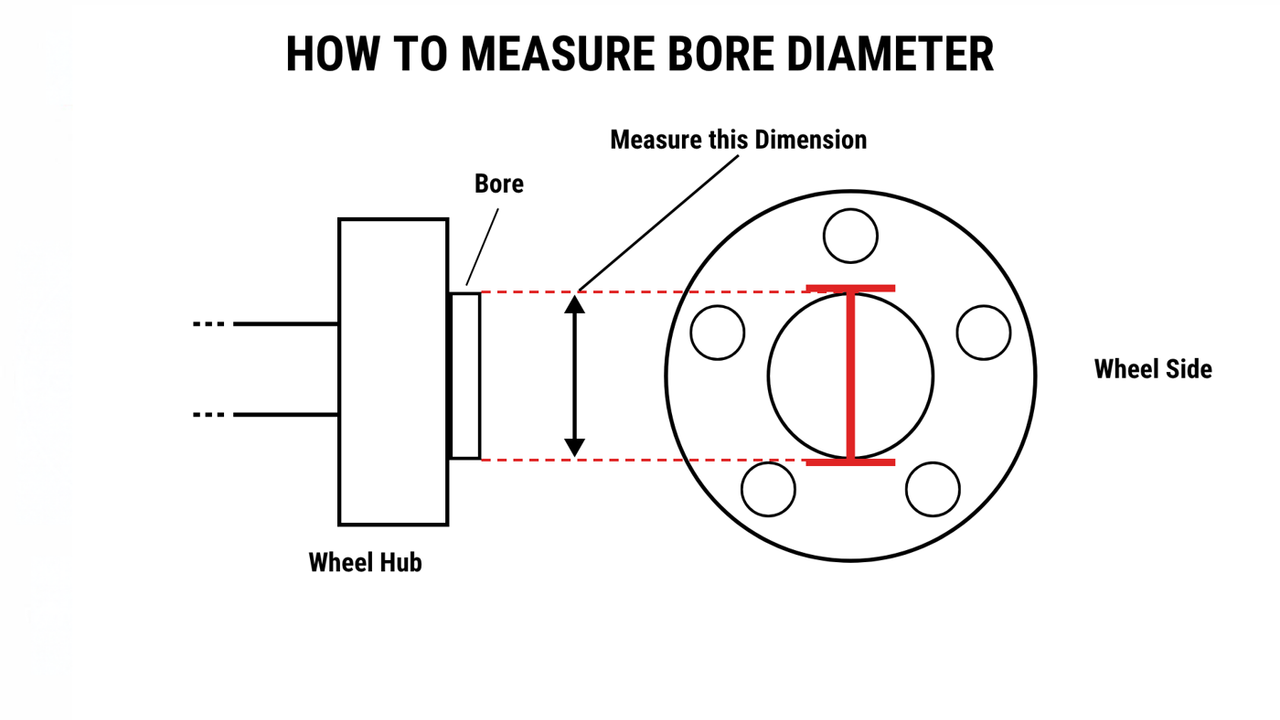
- Clean the rust and paint off the pilot ring with a wire brush; a scale of rust adds a millimeter and rounds a 65 mm bore up to a "66."
- Set your caliper across the widest point of the ring, outside jaw to outside jaw, and read it. Take it twice at 90° to each other; if the two readings differ, the ring is worn or you're not across the true diameter.
- Measure the height of the pilot ring too (how far it stands proud of the hub face). A spacer's bore has to be deep enough to swallow that lip, or the spacer won't sit flat.
Why hub-centric matters more on a tractor than on a car
A car's wheel spends most of its life rolling straight on pavement. A tractor's front wheel takes side loads every time you turn under a full loader bucket, and the rear takes shock loads from implements. A lug-centric spacer, one that only locates on the studs, transfers all of that into the studs as shear. A hub-centric spacer locates on the hub pilot, so the pilot carries the weight and the studs only do what they were designed to do: clamp. That is why every Bora and Stahl spacer we sell is machined hub-centric and wheel-centric to the specific machine, with its own pilot ring for your wheel on the outer face.
How to measure thread pitch on wheel studs
Thread pitch trips up more buyers than anything else, because two studs can look identical and be a quarter-millimeter apart. Tractors use both systems: inch (SAE) threads described by diameter and threads per inch (TPI), like 1/2"-20 or 9/16"-18, and metric threads described by diameter and the distance between threads, like M12 × 1.5 or M16 × 1.5.
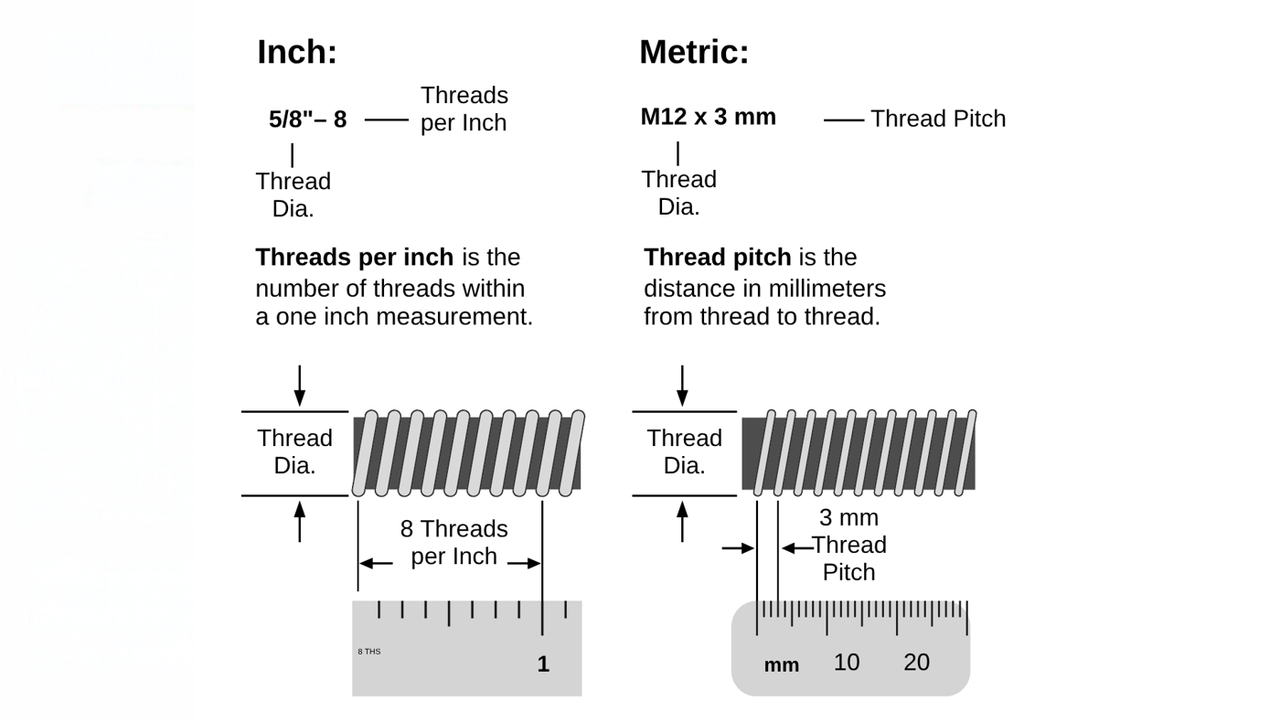
Method 1: thread pitch gauge (best)
A thread pitch gauge is a fan of thin steel leaves, each cut to one pitch. Open it, hold a leaf against the stud's threads and look at it edge-on against the light. When the leaf's teeth drop fully into the thread with no daylight showing, read the number stamped on that leaf. Most gauges carry both SAE and metric leaves. They cost about ten dollars at any hardware store, and it's the only method that can tell M12 × 1.25 from M12 × 1.5 with certainty.
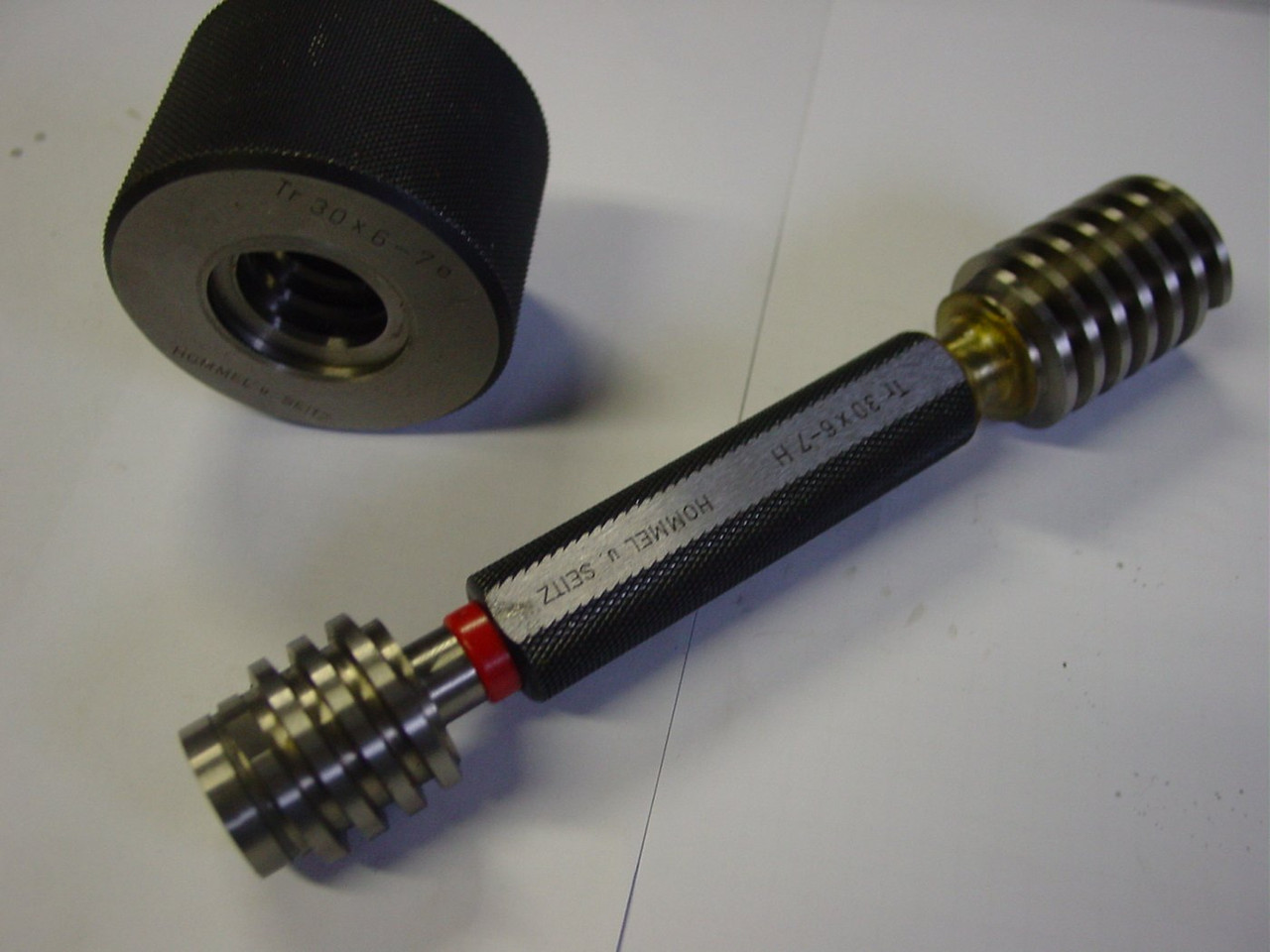
Thread pitch gauge. Photo: Christoph Baumgartinger, Wikimedia Commons, CC BY-SA 2.5.
Method 2: the known-nut test
If you don't have a gauge, use nuts of a known size. A nut that spins on freely by hand for the full length of the stud is the right pitch. A nut that starts, then binds after two turns, is the wrong pitch, even if the diameter matches. Stop before you force it; that's how studs get cross-threaded.
Method 3: ruler count (SAE only)
Lay a ruler along the stud and count the thread peaks in exactly one inch. Twenty peaks is a -20 thread, eighteen is -18. This works well for inch threads and poorly for metric, where the difference between 1.25 and 1.5 mm is too small to count reliably.
Measure stud diameter and length while you're there
With the caliper, measure across the outside of the threads for the nominal diameter (a "1/2 inch" stud reads about 0.49"; an M12 reads about 11.8 mm). Then measure how far the stud sticks out past the hub face. Your spacer's thickness has to leave enough stud for the spacer nut to get full thread engagement, and on thin spacers the stud can't poke out past the spacer face into the wheel. This is one reason spacers under 1.5" are rare on tractors.
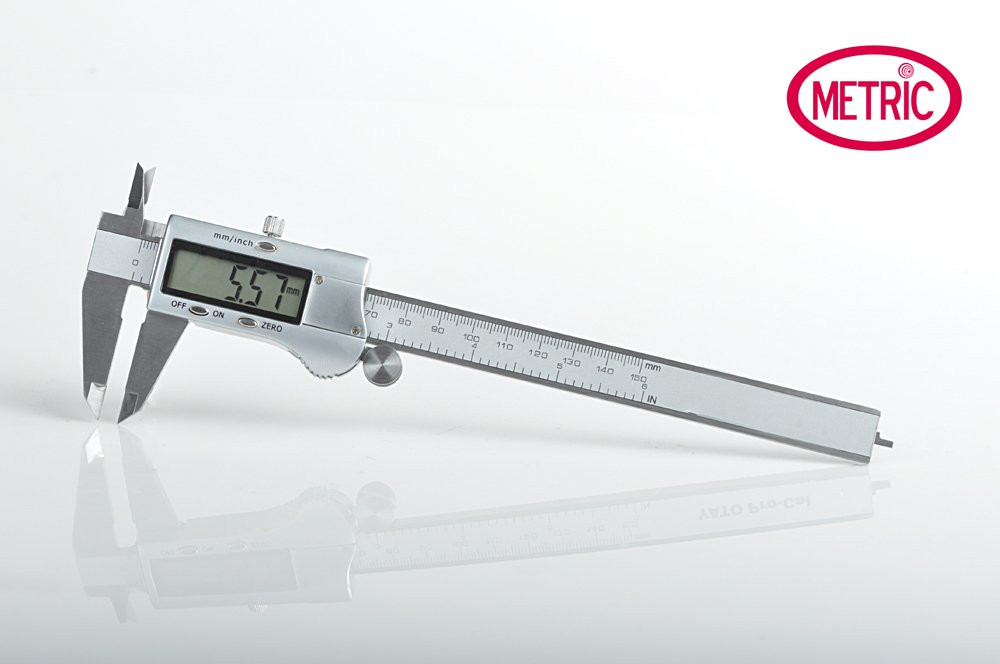
A digital caliper reads inches or millimeters at the push of a button. Photo: Lior Streng, Wikimedia Commons, CC BY-SA 4.0.
Write it down: your spacer spec sheet
By now you have everything a machinist needs. Fill this in for the front axle and again for the rear:
| Spec | Front | Rear |
|---|---|---|
| Tractor make / model / year | ||
| Lug count | ||
| Bolt circle diameter (in or mm) | ||
| Hub pilot OD (center bore) | ||
| Hub pilot height | ||
| Stud diameter & pitch (e.g. M12 × 1.5) | ||
| Stud length past hub face | ||
| Wheel center-hole ID (if aftermarket wheels) | ||
| Spacer width wanted |
Got your numbers? Match them against your machine's listing.
Every tractor on our site has its own spacer page, machined to that hub. Popular ones: John Deere 1025R wheel spacers from $434 a pair, Kubota BX23S wheel spacers from $386, Kubota L2501 and Kioti CK2610 from $484. Free shipping to the lower 48 is in the price.
Shop tractor wheel spacers by make ➔
Model not listed, or your numbers don't match the page? Email your spec sheet to info@utvpartsandaccessories.com or call 800-596-0785 (M-F 11AM-4PM CST) and we'll check it before you order.
Picking a spacer width
Bora and Stahl spacers come in 1.5" to 6.0" widths, sold in pairs. The right width is a trade-off between stability and fitting inside your fenders and loader arms.
- Start by measuring the room you have. With the wheel straight, measure from the outer sidewall of the tire to the inside of the fender, the loader arm, and (up front) the steering linkage at full lock. Your spacer width has to be less than the smallest of those, with clearance left for tire flex.
- 2" is the most common tractor choice for a reason: it noticeably widens the stance without pushing the tire past the fender on most compact and sub-compact machines. Go wider on the rear for loader and side-hill work; keep the front modest so the steering geometry stays close to stock.
- Front and rear don't have to match. Many owners run 2" front and 3" or 4" rear on a loader tractor. Total track-width gain is twice the spacer width (one spacer per side).
- Loader and implement work favors steel. Stahl steel spacers are rated at 40,000 lb per axle versus 30,000 lb for Bora 6061-T6 aluminum. Aluminum is lighter and anodized against corrosion; steel is the pick if you're routinely at the loader's lift limit. Our guide on whether tractor wheel spacers are safe walks through the aluminum-vs-steel decision in more detail.
Installing and torquing wheel spacers
Installation is bolt-on and takes about 20 minutes a wheel, but the torque steps are not optional. Spacers add a second bolted joint between hub and wheel, and a loose joint is how studs get sheared.
- Clean both faces. Wire-brush the hub face and pilot ring. Any rust scale or paint between hub and spacer will crush over the first few hours and leave the nuts loose.
- Seat the spacer on the pilot and thread on the supplied spacer nuts by hand. Tighten in a star pattern, in stages, to your tractor's published wheel-nut torque. Use the figure from your operator's manual, not a generic chart; front and rear are usually different.
- Mount the wheel on the spacer's studs with your original lug nuts (or the nuts supplied with the spacer if the stud size changed) and torque the same way.
- Re-torque after the first 5 to 10 hours of use and check again at 50 hours. This is the step everyone skips and the one that matters most. Add it to your grease schedule.
- Use a torque wrench, not an impact. An impact gun will over-torque an aluminum spacer and can crack it, or under-torque and leave it loose. Either way you won't know until a stud lets go.
Frequently asked questions
Can I use car or truck wheel spacers on a tractor?
Only if the bolt pattern, center bore and thread pitch all match, and they almost never do. Tractor hubs use bolt circles and pilot diameters you won't find on automotive spacers, and automotive spacers are rated for a car's static load, not a loader bucket at full reach. Buy spacers machined for the tractor.
My tractor isn't on your list. Can you still make spacers for it?
Usually, yes. Send us the spec sheet from this guide (front and rear) and photos of the hub face. We'll confirm whether the manufacturer can machine to your numbers before you commit, because spacers are machined to order and, per the manufacturer's policy, steel spacers, anything over 2" thick and special orders can't be cancelled or returned after three days.
Do wheel spacers change my bolt pattern?
Not the ones we sell. Bora and Stahl spacers are pattern-to-same-pattern: the outer face carries the same bolt pattern and a matching pilot ring, so your factory wheels bolt straight on. Adapter spacers that convert one pattern to another exist, but they need a different measuring process and a different conversation; call us.
Are hub-centric wheel spacers really better than lug-centric?
On a tractor, yes, and it isn't close. Hub-centric spacers carry the vehicle's weight on the hub pilot and let the studs do only clamping. Lug-centric spacers put shear and bending into the studs on every turn and every implement bounce. That's the failure mode people are thinking of when they ask if spacers are safe.
I measured in millimeters but the listing shows inches. Which is right?
Both can be. Many tractor patterns are true metric (for example a 6 × 205 mm rear) and some are true inch. Convert your reading and compare to the nearest standard size; a caliper reading of 114 mm is a 4.5" (114.3 mm) pattern. If your number sits between two standard sizes, measure again from the hub, not the wheel, or send us the reading and we'll sort it out.
Do wheel spacers ship free?
Yes, all of our tractor wheel spacers include free shipping to the lower 48 states. Pairs are machined to order in the USA; lead time is shown on each product page.